


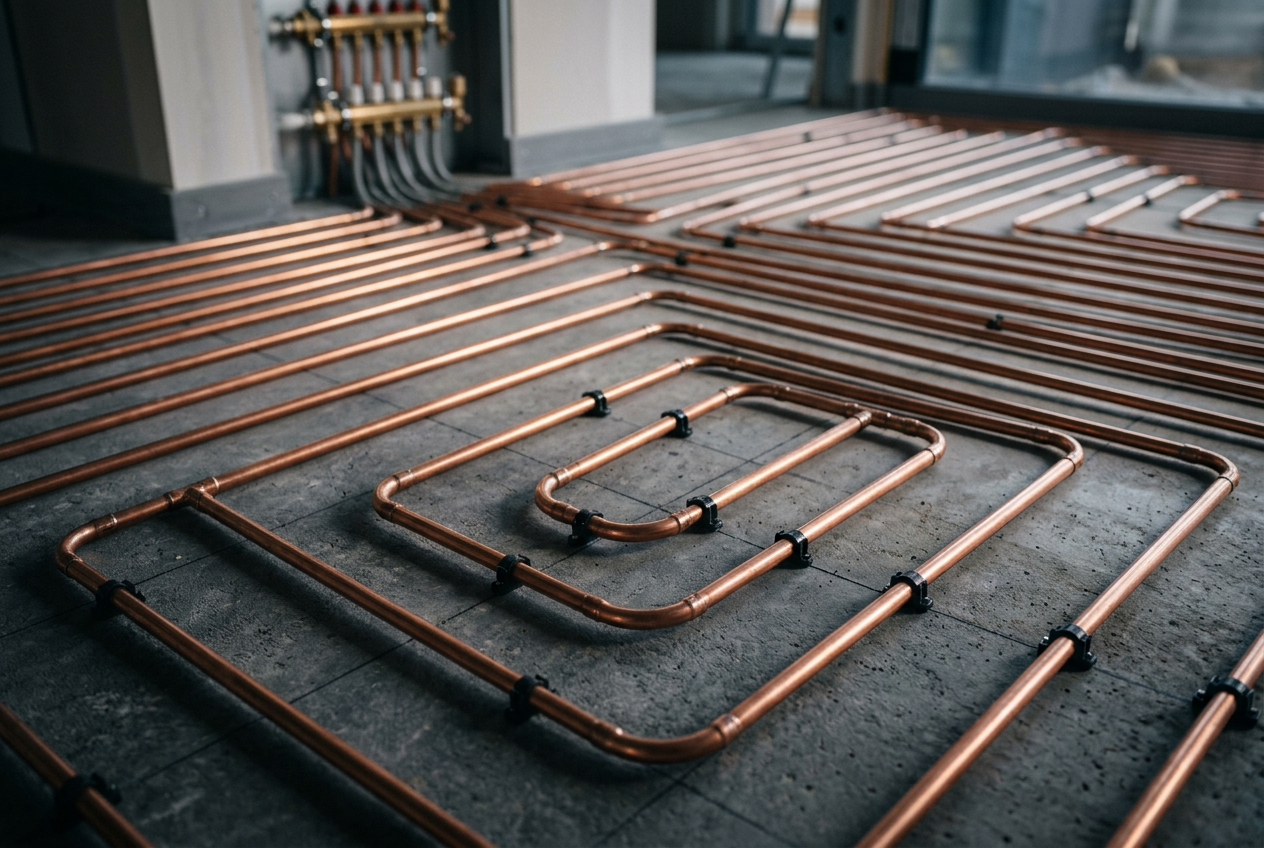
Underfloor heating is not a luxury add-on — it is a critical system in any high-end home. Amit Marshanski, founder of Marshanski Build, is unequivocal: you should never skip underfloor heating in a luxury build, despite the common hesitation many homeowners feel about the investment. With increasingly extreme climate shifts affecting Israel and the wider region, a properly designed radiant floor heating system delivers unmatched comfort, energy efficiency, and long-term value that no other heating method can replicate.
Why So Many Homeowners Hesitate — And Why They Shouldn’t
It’s understandable that underfloor heating raises eyebrows during the budgeting phase of a luxury build. The upfront installation cost for a hydronic (water-based) radiant floor system in a high-end Israeli home typically ranges between ₪150–₪300 per square meter, depending on floor area and system complexity. For a 400 m² villa, that translates to roughly ₪60,000–₪120,000 before the heat source and controls.
But Amit Marshanski sees this differently. “Everyone recoils from the cost,” he says, “but once you live with it, you realize it’s non-negotiable. I wouldn’t give it up at any stage.” The reality is that this investment pays dividends every winter for decades — through lower energy bills, zero maintenance of bulky radiators, and a level of thermal comfort that forced-air or baseboard systems simply cannot match.
How Underfloor Heating Works in a Luxury Build
The system Marshanski Build recommends — and installs in its projects — is a hydronic radiant floor system powered by an inverter heat pump. Here’s the breakdown:
- Water-based heating loops: Flexible PEX or PE-RT pipes are embedded in the floor screed, creating independent circuits (zones) throughout the home.
- Inverter-driven heat pump: Unlike standard on/off boilers, an inverter compressor modulates its output. It delivers low, continuous power rather than cycling between full blast and off. This is the key to keeping electricity bills reasonable.
- Zone manifolds: A central manifold for each area of the home distributes heated water to individual loops. Temperature is controlled via simple valve adjustments at each manifold.
Amit explains his practical philosophy: “I wouldn’t overthink the automation. I’d set up a manifold for each zone, control the temperature through the valves, and in most cases you set it once and live with it. At my own home, the system kicks in automatically and shuts off automatically — and I wouldn’t give it up for anything.”
The Inverter Advantage: Low Power, Steady Comfort
One of the biggest myths about underfloor heating is that it’s expensive to run. Traditional electric mat systems can be — consuming 100–150 W per square meter and spiking your electricity bill dramatically. But a hydronic system paired with a modern inverter heat pump changes the equation entirely.
An inverter heat pump achieves a Coefficient of Performance (COP) of 4.0–5.0, meaning for every 1 kWh of electricity consumed, it produces 4–5 kWh of heat. Compare that to a conventional electric heater’s COP of 1.0, and the efficiency gains become enormous. For a 300 m² luxury home in the Israeli Sharon region, monthly heating costs with an inverter-driven hydronic system typically run between ₪400–₪800 during peak winter months — a fraction of what forced-air or electric systems would cost.
The inverter’s ability to operate at partial load — say 30–40% capacity — for extended periods is what makes it so effective. Instead of blasting heat and shutting down, it maintains a gentle, consistent warmth. The floor itself acts as a massive thermal battery, slowly radiating heat upward at an even 22–24°C surface temperature.
Climate Change Makes This Decision Easier
Israel’s winters are becoming more unpredictable. The Israel Meteorological Service has recorded an increase in cold-snap events and temperature volatility over the past decade. Kfar Shmaryahu, Savyon, Herzliya Pituach, and other affluent coastal and central areas experience damp, penetrating cold from December through March that makes poorly heated homes genuinely uncomfortable.
Amit Marshanski puts it bluntly: “We’re heading into an era of extreme climate shifts. There’s no question anymore — underfloor heating needs to be part of the plan.” A luxury home built without it isn’t just missing a feature; it’s missing a core infrastructure element that affects livability for 4–5 months every year.
Compatibility with Premium Flooring Materials
Underfloor heating pairs exceptionally well with the flooring materials most commonly specified in luxury Israeli homes. Natural stone and marble — popular choices in high-end builds — are excellent thermal conductors, transferring heat efficiently and evenly from the embedded pipes to the room above. Porcelain tiles perform equally well.
Engineered hardwood floors are also compatible, provided the right species and thickness are selected (generally under 15 mm for the top layer). Marshanski Build coordinates closely with flooring suppliers and architects to ensure the heating system and floor finish work in harmony. For a deeper dive into premium flooring options for Israeli luxury homes, see our guide on luxury flooring options in Israel: comparing marble, wood, and stone materials.
Installation: When and How It’s Done Right
Proper underfloor heating installation must happen at a specific stage in the construction timeline. The pipes are laid after the structural slab is complete and insulation boards are in place, but before the screed pour. Retrofitting is possible but significantly more expensive and disruptive — which is why planning it into a new build or major renovation is critical.
Here’s Marshanski Build’s recommended installation sequence:
- Insulation layer: Extruded polystyrene (XPS) boards, typically 30–50 mm, are placed over the structural slab to prevent heat loss downward.
- Pipe layout: PEX pipes are arranged in spiral or serpentine patterns at 100–150 mm spacing, secured to the insulation with clips or rail systems.
- Pressure testing: The entire system is pressurized to 6 bar and held for 24 hours to verify there are no leaks before any concrete is poured.
- Screed pour: A 65–75 mm self-leveling or semi-dry screed encases the pipes, creating the thermal mass.
- Manifold and pump connection: Zone manifolds are mounted in dedicated cabinet recesses, connected to the inverter heat pump.
- Commissioning: The system is gradually brought up to temperature over 3–5 days to cure the screed and calibrate flow rates.
Understanding how this fits into the broader construction process is essential for budgeting. Our article on timeline and cost comparison: building new vs. renovating existing homes in Israel covers how mechanical systems like underfloor heating affect your project schedule.
The Real Cost in Context
When you’re building a luxury home in Israel — where total construction costs often range from ₪12,000 to ₪25,000+ per square meter — the underfloor heating system represents roughly 1–2% of total build cost. Skipping it to save that margin is, as Amit Marshanski argues, a false economy.
Consider what you gain: invisible heating with no wall-mounted units disrupting your interior design, elimination of dust circulation (a major issue with forced-air systems), and a system lifespan of 50+ years for the piping itself. For detailed budget planning on luxury builds, check our cost of building a luxury home in Israel: price breakdown and budget planning guide.
Amit Marshanski’s Personal Setup
Amit doesn’t just recommend underfloor heating to his clients — he lives with it. His own home runs a fully automatic hydronic system: the inverter heat pump activates based on preset temperature thresholds, heats the water circulating through floor loops, and shuts off when the target is reached. No daily adjustments needed. No fiddling with thermostats room by room.
“You set the temperature once, and you live with it,” he says. “The system starts on its own, stops on its own. It’s the kind of comfort that becomes invisible — and that’s exactly the point in a luxury home.”
Frequently Asked Questions
How much does underfloor heating cost to install in a luxury home in Israel?
A hydronic underfloor heating system typically costs ₪150–₪300 per square meter for installation, including pipes, insulation, manifolds, and screed. The inverter heat pump adds ₪15,000–₪40,000 depending on capacity. For a 400 m² home, total system cost is usually ₪75,000–₪160,000.
Is underfloor heating energy-efficient enough for large homes?
Yes. When paired with an inverter heat pump (COP of 4.0–5.0), a hydronic system uses a fraction of the energy of electric heaters or forced-air systems. Monthly winter running costs for a 300 m² home are typically ₪400–₪800, making it one of the most efficient heating solutions available.
Can underfloor heating work with marble and natural stone floors?
Absolutely. Marble and natural stone are excellent thermal conductors and are among the best flooring materials for radiant heating. They transfer heat evenly and retain warmth effectively, making them an ideal pairing for luxury builds.
How long does an underfloor heating system last?
The PEX or PE-RT pipes used in hydronic systems have an expected lifespan of 50+ years. The inverter heat pump typically lasts 15–20 years before requiring replacement. Manifold valves and controls may need servicing every 10–15 years.
Is it possible to retrofit underfloor heating in an existing home?
Retrofitting is technically possible but involves removing existing flooring, adding insulation and pipes, pouring new screed, and re-laying the floor finish. This adds significant cost and time. It is far more practical and cost-effective to install during new construction or a full renovation.
Build It Right the First Time
Underfloor heating isn’t a trend or a nice-to-have — it’s foundational infrastructure for any serious luxury home. Marshanski Build, specializing in high-end residential construction in Kfar Shmaryahu, Savyon, Herzliya Pituach, and Israel’s most prestigious neighborhoods, integrates hydronic radiant floor systems into every project as standard practice.
Planning a luxury build or major renovation? Contact Marshanski Build to discuss how underfloor heating — and every other critical system — should be designed into your home from day one. Visit marshanski.com or reach out directly to Amit Marshanski and his team.