

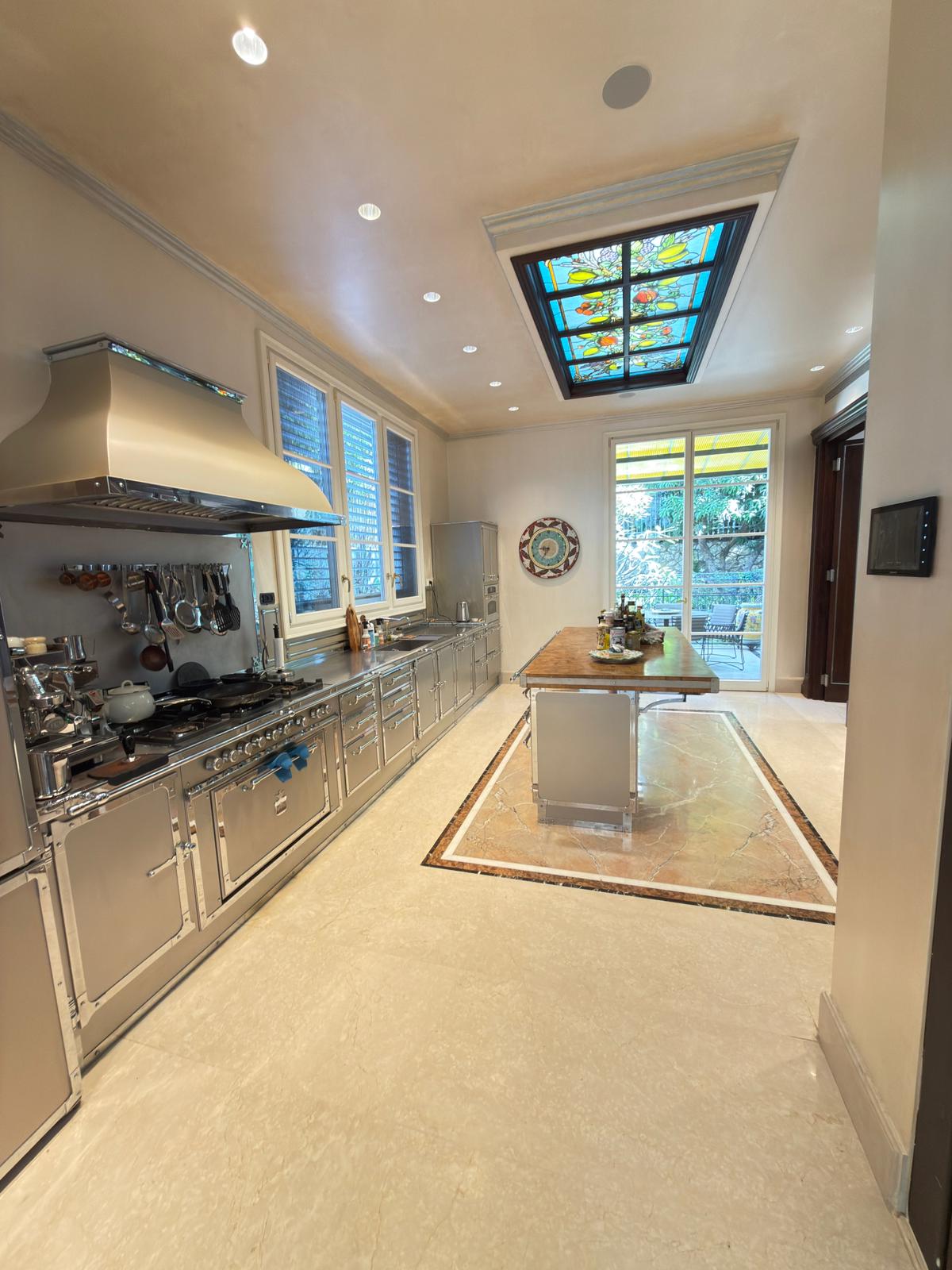
The luxury kitchen is the single most important functional space in any home — used at least three times a day, it serves as the household’s operational core and social hub. Getting your luxury kitchen right means nailing four critical decisions: its placement in the floor plan, the manufacturer you choose, the style and materials, and — above all — the hardware (“parzol”) that determines whether your kitchen lasts 5 years or 30. At Marshanski Build, specializing in high-end private construction across Israel’s most prestigious neighborhoods, we treat luxury kitchen planning as the first atom of every custom home project.
Luxury Kitchen Placement: Where It Sits Changes Everything
Before selecting cabinet colors or countertop stone, the most consequential luxury kitchen decision is where it lives inside the house. A luxury kitchen needs to be positioned in relation to three elements: the main living area, a dedicated pantry (“mazveh”), and — ideally — a breakfast terrace that extends the morning routine outdoors.
In our projects in Kfar Shmaryahu, Savyon, and Herzliya Pituach, we typically allocate 25–40 square meters for the luxury kitchen zone alone, not including the pantry or adjacent outdoor dining. This is roughly double the 12–18 sqm standard in typical Israeli apartments. The extra space isn’t about luxury for its own sake — it’s about creating proper work triangles, accommodating two cooks simultaneously, and integrating a large island that doubles as a casual dining area.
The Pantry Connection
A walk-in pantry adjacent to the luxury kitchen is no longer optional in high-end homes. It keeps the kitchen visually clean by hiding small appliances, bulk storage, and rarely used items. The pantry door should be positioned so it’s invisible from the main living space — a detail that requires coordination between the architect and builder from day one.
The Breakfast Terrace
Connecting your luxury kitchen to an outdoor breakfast terrace through wide-opening glass doors transforms morning routines entirely. In Israel’s climate, this terrace gets used 9–10 months per year. The transition between indoor and outdoor flooring should be seamless — something we discuss in detail in our guide to luxury flooring options in Israel.
Kitchen Manufacturer vs. Private Carpenter: The Definitive Answer
One of the most common debates among homeowners building a luxury kitchen is whether to commission it from a professional kitchen company or from a private carpenter. The answer is unequivocal: go with a kitchen company.
Here’s why. Kitchen manufacturers operate with CNC precision machinery, factory-controlled environments, and standardized quality processes. A private carpenter — no matter how talented — works with hand tools and improvisation. The tolerances in luxury kitchen production are measured in fractions of a millimeter. Doors need to align perfectly. Soft-close mechanisms require exact mounting. Integrated appliances demand precise cutouts that match manufacturer specifications to the decimal.
Choosing the Right Kitchen Company for Your Luxury Kitchen
Not all kitchen companies are equal. Each manufacturer has its own specialization and positioning:
- German manufacturers (e.g., Poggenpohl, SieMatic, Leicht) — known for engineering precision, modular systems, and restrained European aesthetics. Price range in Israel: ₪250,000–₪600,000+ for a full luxury kitchen.
- Italian manufacturers (e.g., Boffi, Dada, Poliform) — excel in bold design, lacquer finishes, and sculptural island compositions. Often 15–25% more expensive than German equivalents.
- Israeli premium manufacturers — offer strong value, faster lead times (8–12 weeks vs. 16–24 weeks for European imports), and local service. Price range: ₪120,000–₪300,000.
The choice should align with the overall architectural language of the home. A minimalist concrete-and-glass villa calls for a different luxury kitchen personality than a Mediterranean stone estate. This is part of what separates truly luxurious construction from standard building.
Kitchen Hardware: The Hidden Factor That Defines Luxury Kitchen Longevity
If there is one element homeowners consistently underestimate, it’s kitchen hardware — the hinges, drawer slides, lift mechanisms, pull-out systems, and internal organizers that make up the luxury kitchen’s mechanical skeleton. This is the “parzol” that determines whether your kitchen feels luxurious on day one and still feels luxurious on year twenty.
A well-built luxury kitchen should last 20 to 30 years without requiring structural replacement. That kind of lifespan depends almost entirely on hardware quality. The industry benchmark is set by brands like Blum (Austria) and Hettich (Germany), whose mechanisms are tested for 80,000+ opening cycles — equivalent to roughly 40 years of daily use.
What to Specify in Your Luxury Kitchen Hardware
- Soft-close hinges on every door — not just a comfort feature; it prevents the micro-impacts that loosen cabinet joints over time.
- Full-extension drawer slides — drawers should pull out 100% of their depth so nothing gets lost in the back. Look for slides rated for 40–65 kg load capacity.
- Lift-up mechanisms for wall cabinets — AVENTOS-style systems by Blum allow upper cabinet doors to swing upward and stay open, giving unobstructed access.
- Internal drawer organizers — factory-fitted dividers for cutlery, spices, and utensils keep the luxury kitchen functional for decades, not just the first week.
- Integrated LED lighting — under-cabinet and in-drawer lighting isn’t decorative. It’s functional, especially for upper cabinets and deep pantry shelves.
Skimping on hardware to save ₪10,000–₪20,000 on a ₪200,000+ luxury kitchen is one of the most common — and most regrettable — decisions homeowners make.
Planning the Luxury Kitchen as Part of the Whole Home
The luxury kitchen doesn’t exist in isolation. Its electrical infrastructure (dedicated circuits for ovens, induction cooktops, and refrigeration), plumbing (hot and cold supply, waste lines, gas connections), and ventilation (extraction hoods rated at 800–1,200 m³/h for serious cooking) all need to be planned during the structural phase of construction — not after the walls are up.
At Marshanski Build, luxury kitchen coordination begins during schematic design. We work directly with the kitchen manufacturer’s technical team to ensure that wall reinforcements, electrical outlets, water points, and gas lines are positioned exactly where the final kitchen design requires them. This eliminates the costly “open the wall again” problem that plagues projects where the kitchen is treated as an afterthought.
For homeowners weighing whether to build new or renovate, this integration advantage is a major factor. We break down the full comparison in our timeline and cost comparison between building and renovating.
Luxury Kitchen Countertops and Surfaces: Matching Form to Function
The countertop is the luxury kitchen’s most visible surface and its hardest-working one. The three dominant choices in Israeli luxury kitchens are:
- Natural stone (marble, granite) — unmatched aesthetic depth, but requires periodic sealing. Marble stains if not maintained. Granite is more forgiving.
- Engineered quartz (Caesarstone, Silestone) — extremely durable, non-porous, available in consistent colors. The most popular choice for families, with prices starting around ₪1,200–₪2,500 per linear meter installed.
- Dekton / Neolith (sintered stone) — virtually indestructible, heat-resistant, UV-stable. Ideal for indoor-outdoor luxury kitchens. Premium pricing: ₪2,000–₪4,000 per linear meter.
The right choice depends on cooking habits, aesthetic goals, and maintenance tolerance. A serious home cook who uses hot pans directly on the surface needs Dekton. A homeowner who prioritizes the veining of natural marble accepts the maintenance trade-off.
Luxury Kitchen Design Trends in Israel for 2025
The luxury kitchen landscape in Israel is evolving rapidly. Key trends shaping high-end kitchen design in 2025 include:
- Handleless cabinetry — push-to-open and recessed grip profiles create sleek, uninterrupted surfaces that define modern luxury kitchen aesthetics.
- Integrated appliance columns — ovens, steam ovens, coffee machines, and wine coolers concealed behind uniform panel fronts for a seamless look.
- Thin-profile countertops — 12mm Dekton and Neolith slabs replacing traditional 30mm thickness for a more architectural, contemporary appearance.
- Hidden kitchens — pocket-door systems that allow the entire luxury kitchen to disappear behind cabinetry when not in use, popular in open-plan living layouts.
- Smart kitchen technology — connected appliances, automated lighting, and voice-controlled ventilation systems integrated into the kitchen’s design from the planning stage.
Frequently Asked Questions About Luxury Kitchens
How much does a luxury kitchen cost in Israel?
A high-end luxury kitchen in Israel typically ranges from ₪150,000 to ₪600,000+, depending on the manufacturer, materials, and appliance package. European imports (German or Italian) sit at the upper end, while Israeli premium manufacturers offer strong quality in the ₪120,000–₪300,000 range.
Should I use a kitchen company or a private carpenter for a luxury kitchen?
Always choose a professional kitchen company for your luxury kitchen. Factory-grade CNC precision, standardized quality control, and tested hardware integration are impossible to replicate in a carpentry workshop. The difference becomes obvious within 3–5 years of daily use.
How long should a luxury kitchen last?
A properly built luxury kitchen with high-quality hardware (Blum, Hettich) should last 20 to 30 years without structural replacement. Premium hardware is tested for 80,000+ opening cycles, equivalent to roughly 40 years of daily use.
What is the best countertop material for a luxury kitchen in Israel?
Engineered quartz is the most popular all-around choice for durability and low maintenance in a luxury kitchen. Dekton or Neolith sintered stone is ideal for homes with indoor-outdoor kitchens or serious cooks who place hot pans directly on surfaces. Natural marble offers unmatched beauty but requires regular sealing and careful use.
When should luxury kitchen planning start in a new home build?
Luxury kitchen planning should begin during the schematic design phase — before structural walls are built. Electrical circuits, plumbing lines, gas connections, and wall reinforcements all need to be coordinated with the kitchen manufacturer’s technical specifications to avoid costly rework later.
What are the best luxury kitchen brands available in Israel?
The top luxury kitchen brands available in Israel include German manufacturers like Poggenpohl, SieMatic, and Leicht, Italian brands such as Boffi, Dada, and Poliform, and several Israeli premium manufacturers. Each offers distinct advantages in design language, pricing, and lead times.
Build Your Luxury Kitchen the Right Way — From Day One
The luxury kitchen is where your home’s design ambition meets daily reality. It deserves the same engineering precision and material quality as the structure itself. Marshanski Build integrates luxury kitchen planning into every high-end home project from the earliest design stage, coordinating directly with leading kitchen manufacturers to deliver spaces that perform beautifully for decades. Ready to start planning the most important room in your home? Contact Marshanski Build for a consultation.