


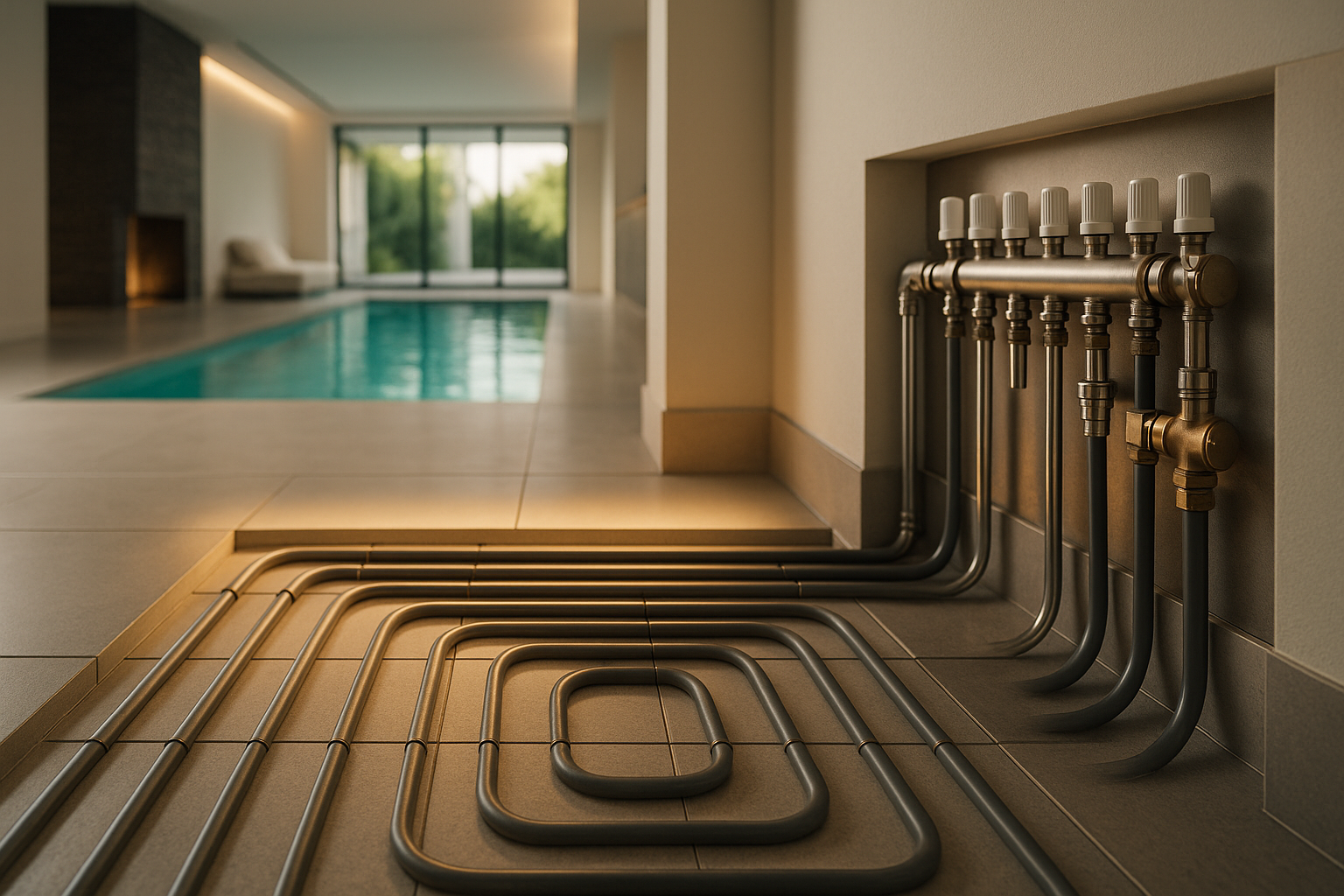
Connecting your underfloor heating system to your pool heating system is technically possible — but in practice, you should keep them separate. While combining both into a single heating loop sounds efficient on paper, the added complexity of three-way valves, control systems, and long pipe runs between the roof and pool area creates maintenance headaches, energy waste, and operational difficulties that outweigh any theoretical savings. Amit Marshanski of Marshanski Build, with extensive experience building luxury homes in Israel, firmly recommends separating the two systems.
Why the Question Keeps Coming Up
Homeowners building a new villa with both a swimming pool and underfloor heating naturally ask: “Can one boiler or heat pump serve both?” It seems logical. After all, both systems circulate hot water through pipes. Mechanical consultants sometimes recommend combining them because the seasonal demand profiles barely overlap — you heat your floors in winter and your pool mostly in spring and autumn.
The reasoning sounds solid. Pool heating demand peaks during shoulder seasons (March–May and September–November), while underfloor heating runs hardest from December through February. In theory, a single oversized heat pump or solar array could handle both loads without major conflict. But theory and reality diverge sharply once you start laying pipes and programming controllers.
The Real-World Problems with an Underfloor Heating Pool Heating Combined System
Complex Plumbing and Control Infrastructure
Merging the two heating loops requires three-way diverter valves, mixing valves, and a sophisticated control system to route hot water to the right destination at the right time. This control layer adds roughly ₪15,000–₪30,000 in valves, actuators, and automation hardware alone. More critically, these components become failure points — a stuck valve in January can leave your entire house without heat.
Every homeowner we’ve spoken with who went the combined route reports the same frustration: the system is difficult to operate. You need to understand which mode is active, manually override settings during transition weeks, and troubleshoot issues that wouldn’t exist in a simpler setup.
Long Pipe Runs Waste Energy and Money
Here’s a detail many consultants overlook. Pool heating equipment — whether a heat pump or solar collectors — is typically located adjacent to the pool, often in a technical room at ground level or poolside. Home underfloor heating boilers, heat pumps, or solar systems sit on the roof or in a mechanical room inside the house.
The moment you combine these systems, you need to run main supply and return lines between the roof and the pool area — potentially 40–60 meters of insulated piping each way. That’s a massive amount of heat loss in transit, wasted pump energy pushing water over long distances, and an additional pressurized water system running through the building’s structure. It’s unnecessary complexity inside your walls and ceilings.
Maintenance Becomes a Headache
Separate systems mean separate maintenance. If your pool heater needs servicing, your house stays warm. If your underfloor manifold has an issue, your pool stays heated. With a combined system, any maintenance event on the shared components — the main pump, the diverter valves, the controller — affects both systems simultaneously.
Pool water chemistry also introduces corrosion concerns. Although pool heating uses a separate heat exchanger, shared supply lines and components increase the risk of cross-contamination or galvanic corrosion over time, particularly in Israel’s mineral-rich water conditions.
The Cost Argument Doesn’t Hold Up
Proponents of combined systems argue you save money by purchasing one large heat pump instead of two smaller ones. Let’s break that down:
- Additional pipe runs (insulated, 40–60m each way): ₪8,000–₪15,000
- Three-way valves and actuators: ₪5,000–₪10,000
- Advanced control system/automation: ₪8,000–₪20,000
- Additional labor for complex installation: ₪5,000–₪10,000
Total added infrastructure cost: approximately ₪26,000–₪55,000. A dedicated pool heat pump in Israel ranges from ₪12,000–₪35,000 depending on pool size and brand. In many cases, the cost of combining systems exceeds the cost of simply buying a second unit. And even when it doesn’t, the small price difference vanishes once you factor in higher ongoing maintenance and energy losses.
As Amit Marshanski puts it: “Even if a consultant tells you to combine them — remember, the consultant doesn’t live in the house. You do.”
The Recommended Approach: Two Independent Systems
At Marshanski Build, specializing in luxury home construction in Israel, we install separate heating systems for the home and pool in every project. Here’s what that looks like:
Home Underfloor Heating System
- Heat source on the roof — solar thermal collectors or air-source heat pump, with electric backup
- Buffer tank and manifolds in a dedicated mechanical room
- Zone control per room with individual thermostats
- Supply water temperature: 35–45°C (low-temperature system, ideal for underfloor)
Pool Heating System
- Dedicated heat pump installed within 5 meters of the pool equipment pad
- Integrated with pool filtration — water flows through the heater as part of the filter cycle
- Supply water temperature: 28–32°C for the pool
- Optional solar blanket to reduce heat loss by up to 70%
Each system operates independently, is maintained independently, and can be upgraded independently. If you want to add a solar preheat stage to your pool in five years, you don’t need to reconfigure your entire home heating system to do it.
What About Solar Systems?
Solar thermal panels for underfloor heating and solar pool heating are sometimes installed on the same roof. Even in this scenario, we recommend separate collector arrays with separate circulation pumps. Roof-mounted solar pool heating panels (unglazed, low-cost) operate at different efficiency points than the glazed collectors used for underfloor heating. Mixing them compromises both systems’ performance.
A typical Israeli home with 150 m² of heated floor area needs roughly 8–12 m² of glazed solar collectors for underfloor support. A 50 m³ pool needs approximately 25–35 m² of unglazed solar panels. These are fundamentally different technologies serving different temperature targets.
When Might Combining Make Sense?
There are rare edge cases — a very small plunge pool located directly adjacent to the mechanical room, where pipe runs would be under 5 meters. Or a project with severe roof space constraints where a single high-capacity heat pump is the only viable option. But for the vast majority of new luxury homes being built in Israel, separate systems are the right call.
Key Takeaways
- Theory vs. practice: Combined systems work on paper but create real-world operational headaches
- Cost savings are illusory: The extra plumbing, valves, and controls often cost as much as a second heater
- Energy waste: Running main lines between the roof and pool area loses heat and wastes pump electricity
- Simplicity wins: Two independent systems are easier to operate, maintain, and upgrade
- Location logic: Pool heating belongs near the pool; home heating belongs near the home’s mechanical core
Frequently Asked Questions
Can a pool heat pump be used for underfloor heating?
Technically yes — a pool heat pump can produce water at 35–45°C suitable for underfloor systems. However, the pipe runs, control valves, and automation required to share one unit between two systems add significant cost and complexity. A dedicated unit for each system is more reliable and often comparable in total cost.
How much does it cost to separate pool and underfloor heating systems?
A standalone pool heat pump in Israel costs ₪12,000–₪35,000 depending on pool volume. A separate underfloor heating system (heat pump or solar thermal with buffer tank) ranges from ₪30,000–₪80,000 for a typical luxury home. Combined, these are often cheaper to install and maintain than a single merged system with all its required infrastructure.
Is there seasonal overlap between pool heating and home heating demand?
Minimal. Underfloor heating runs primarily from December to February, while pool heating demand peaks in March–May and September–November. This limited overlap is often cited as a reason to combine systems, but the 2–3 weeks of actual concurrent demand don’t justify the year-round complexity of a combined setup.
What does Marshanski Build recommend about an underfloor heating pool heating combined system for luxury homes in Israel?
Marshanski Build consistently recommends fully independent heating systems — pool heating installed near the pool and home underfloor heating with rooftop or mechanical-room equipment. This approach is simpler to operate, easier to maintain, and gives homeowners direct, intuitive control over each system. Learn more about our approach to luxury flooring and integrated heating.
Will my mechanical consultant recommend combining the systems?
Some consultants do recommend it because the engineering logic is sound on paper. But consultants design systems — they don’t live with them daily. The operational simplicity of separate systems is something only a homeowner (or a builder who’s heard the complaints) truly appreciates.
Build Smarter — Talk to Marshanski Build
Planning a luxury home and weighing an underfloor heating pool heating combined system versus two separate units? Marshanski Build brings hands-on construction expertise to every mechanical decision — not just architectural design. We’ve seen what works and what frustrates homeowners for years after the build is complete. Contact us today at marshanski.com to discuss your project and get advice rooted in real-world building experience, not just engineering theory.