

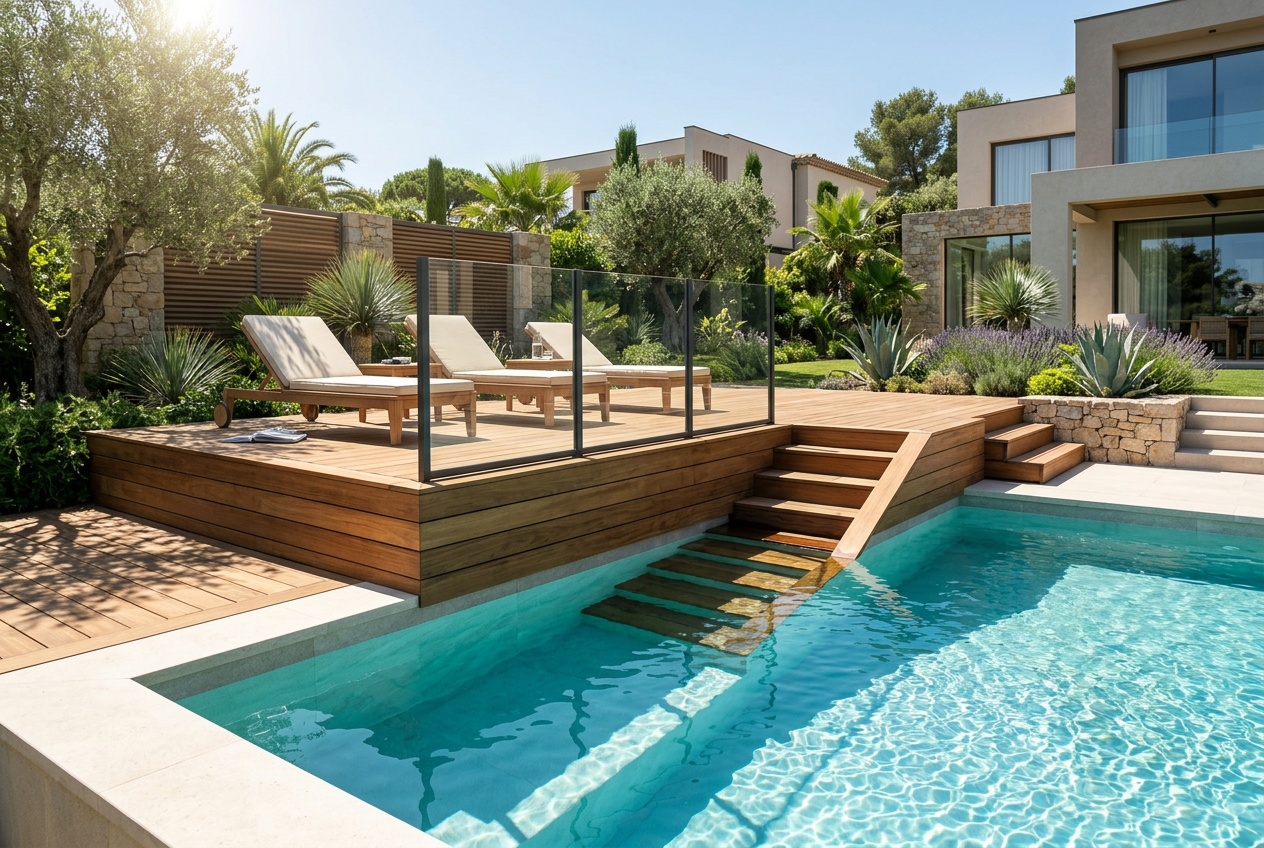
A premium, state-of-the-art movable pool floor allows you to raise the pool floor at the push of a button — transforming it into a dry surface for entertaining, adjusting the depth for children, and eliminating drowning hazards when the pool isn’t in use. In 2026, this is one of the most sought-after technological solutions in the world of private swimming pools.
Why Do You Even Need a Movable Pool Floor?
In three words: safety, space, and flexibility. These are the three main reasons homeowners invest in a movable pool floor system, and each one alone justifies the investment.
Safety — The Number One Reason
An open pool is a constant hazard, especially in homes with young children. According to child safety organizations, drowning is the leading cause of death among children under age 4, and private pools are one of the primary risk zones. A movable pool floor raised to ground level seals the pool completely — no exposed water, no danger. This is a safety solution far superior to a fence or a soft cover, because it creates a stable surface you can stand on and even use for activities.
Converting Pool Square Footage into Usable Ground Space
When the floor is raised to its maximum height, the pool area becomes a flat, stable surface. A 50 m² pool turns into 50 m² of activity space — you can host a party on it, set up tables and chairs, and even use the area as an outdoor entertainment zone. In luxury properties with limited space, the ability to “double” your yard area is a significant advantage that directly impacts property value.
Adjustable Depth for Children
You don’t always need to raise the floor all the way up. A movable pool floor lets you set any desired depth — so a deep pool of 1.80 m becomes a shallow 40 cm wading area suitable for toddlers at the push of a button. No need to build a separate children’s pool, and no need to compromise on pool depth for adults.

Types of Movable Pool Floor Systems
Several types of systems are available on the market, imported from Europe (mainly Spain, Germany, and Belgium) and also manufactured locally in Israel. The differences between them relate to the lifting mechanism, precision level, load-bearing capacity, and maintenance costs.
Telescopic / Hydraulic Piston System
This is the most common system in high-end luxury properties. The mechanism is based on hydraulic pistons or telescopic cylinders installed at the bottom of the pool, supporting the floor from all sides. The advantages:
- High precision — the floor rises and lowers uniformly, without tilting or vibrations
- High load-bearing capacity — advanced systems support up to 250 kg/m², allowing events with dozens of people on the surface
- Long service life — with proper maintenance, a telescopic system lasts 20 years or more
- Quiet operation — raising and lowering is nearly silent
The main drawback is cost — this is the most expensive system, requiring precise planning from the pool’s initial concrete pouring stage.
Chain-Driven System
This system uses heavy-duty steel chains driven by electric motors. The chains are connected to anchor points on the floor and raise it synchronously.
- High mechanical strength — the chain is durable over time and provides good stability
- Relatively simple maintenance — chain components can be replaced without fully dismantling the system
- Mid-range cost — less expensive than telescopic systems, more expensive than cable systems
The drawback — noise levels are higher than telescopic systems, and periodic lubrication of the chains is required.
Cable System
This is the oldest and most well-known system. Steel cables are attached to the pool floor and raised using a winch. This is the technology I recommend least — it appears outdated, is less precise, and can create unevenness in the floor height.
- Lower cost — this is its primary advantage
- Simple installation — also suitable for existing pools (retrofit)
The drawbacks are significant: cables stretch over time, precision is low, and there’s a risk of floor tilting if one cable stretches more than the others. In a luxury property that demands flawless execution, this is a compromise not worth making.

Comparison Summary of the Three Systems
| Criterion | Telescopic | Chain-Driven | Cable |
|---|---|---|---|
| Precision | Very High | High | Medium-Low |
| Load Capacity | Up to 250 kg/m² | Up to 200 kg/m² | Up to 150 kg/m² |
| Noise Level | Low | Medium | Medium-High |
| Cost (50 m² pool) | 500,000–850,000 ILS | 650,000–950,000 ILS | 500,000–750,000 ILS |
| Lifespan | 20+ years | 15–20 years | 10–15 years |
When Should You Plan for a Movable Pool Floor?
The short answer: at the architectural design stage. A movable pool floor system requires early planning of technical pits, electrical and plumbing connections, and special depths in the pool’s concrete shell. Adding such a system to an existing pool is possible but costs 30%–40% more and limits the available technology options.
Situations where a movable pool floor is almost essential:
- Homes with young children — safety alone justifies the investment
- Small lots — when every square meter counts, the ability to convert the pool into usable space is critical
- Homes for entertaining — homeowners who host events will gain flexible entertainment space
- Indoor pools — in pools located inside the house, the ability to “make the pool disappear” completely transforms the character of the space
Synchronizing the System with Home Systems
One of the biggest challenges in installing a movable pool floor is integrating it with other home systems. The filtration system, the combined pool heating and underfloor heating system, drainage, pool lighting — they all need to work in harmony with the movable floor mechanism.
Marshanski Construction, which has built some of the most expensive homes in Israel including a 6,000 m² Hermitage-style residence, has accumulated specific experience in synchronizing these complex systems. When building a luxury property at a cost of 25,000 ILS per m² and above, every detail needs to work flawlessly — including the engineering beneath the water’s surface.
Materials and Waterproofing — The Detail That Determines Lifespan
A movable pool floor operates in an aggressive environment: chlorine, constant humidity, temperature fluctuations, and repeated mechanical loads. The choice of materials — 316L stainless steel for metal components, epoxy coating for the floor, and EPDM gaskets for contact points — is what determines whether the system will last 10 years or 25 years. It’s the same approach of long-term thinking about maintenance and building preservation that characterizes true luxury construction.
Top-tier system suppliers (such as Aqualift from Belgium or EWAC from the Netherlands) provide a 10-year warranty on mechanical parts, but proper installation with precise waterproofing details is what ensures the system lasts well beyond the warranty period.
Additional Costs to Be Aware Of
Beyond the cost of the system itself, you should factor in:
- Annual maintenance — inspection and lubrication, approximately 3,000–5,000 ILS per year
- Electricity — raising and lowering consumes negligible electricity, but the system requires a dedicated three-phase power connection
- Insurance — some insurance companies require an additional premium for mechanical pool systems
- Floor surfacing — the movable floor requires lightweight, durable surfacing, typically synthetic stone or a special composite, at a cost of 500–1,200 ILS per m²
Proper upfront planning of all these components, as part of the overall project budget and timeline planning, prevents costly surprises down the road.

Frequently Asked Questions
Can a movable floor be installed in an existing pool?
Yes, but it’s more complex and expensive. Retrofit installation in an existing pool costs approximately 30%–40% more than installation in a new pool, and sometimes limits which system types can be used. A cable system is often the only option for existing pools.
How long does it take for the floor to rise or lower?
For an average-sized pool of 40–60 m², a full raise takes between 3 and 7 minutes depending on the system type. Telescopic systems are the fastest.
Is the raised floor safe to stand on?
Quality systems comply with European standard EN 13451-11 and support up to 250 kg/m². You can host events on them, place furniture, and even move heavy equipment across them.
How often is maintenance required?
A professional inspection is recommended once a year, including checking seals, lubrication, and testing the hydraulic system. Annual costs range from 3,000 to 5,000 ILS.
Does the system affect pool water quality?
No. A movable pool floor is designed so that the filtration and circulation systems continue operating regardless of the floor’s position. Proper planning of drainage and water circulation is a critical part of the installation.
Summary — Who Is a Movable Pool Floor Right For?
A movable pool floor is not a gadget — it’s a system that adds real value to a property in terms of safety, usage flexibility, and real estate worth. The choice between system types (telescopic, chain-driven, or cable) depends on your budget, pool size, and specific requirements.
The most critical factor is incorporating the system’s design at the architectural planning stage of the home — and this is where the experience of a general contractor with luxury construction expertise makes all the difference. It’s important to remember that choosing the right system isn’t just a matter of daily convenience — it directly impacts your property’s future value, as potential buyers recognize a quality, well-maintained system as a hallmark of the highest-level construction. Amit Marshanski and the Marshanski Construction team guide homeowners through selecting the right system, identifying suitable suppliers (both local and international), and planning seamless integration with all home systems. For a no-obligation initial consultation — contact us through marshanski.com.