

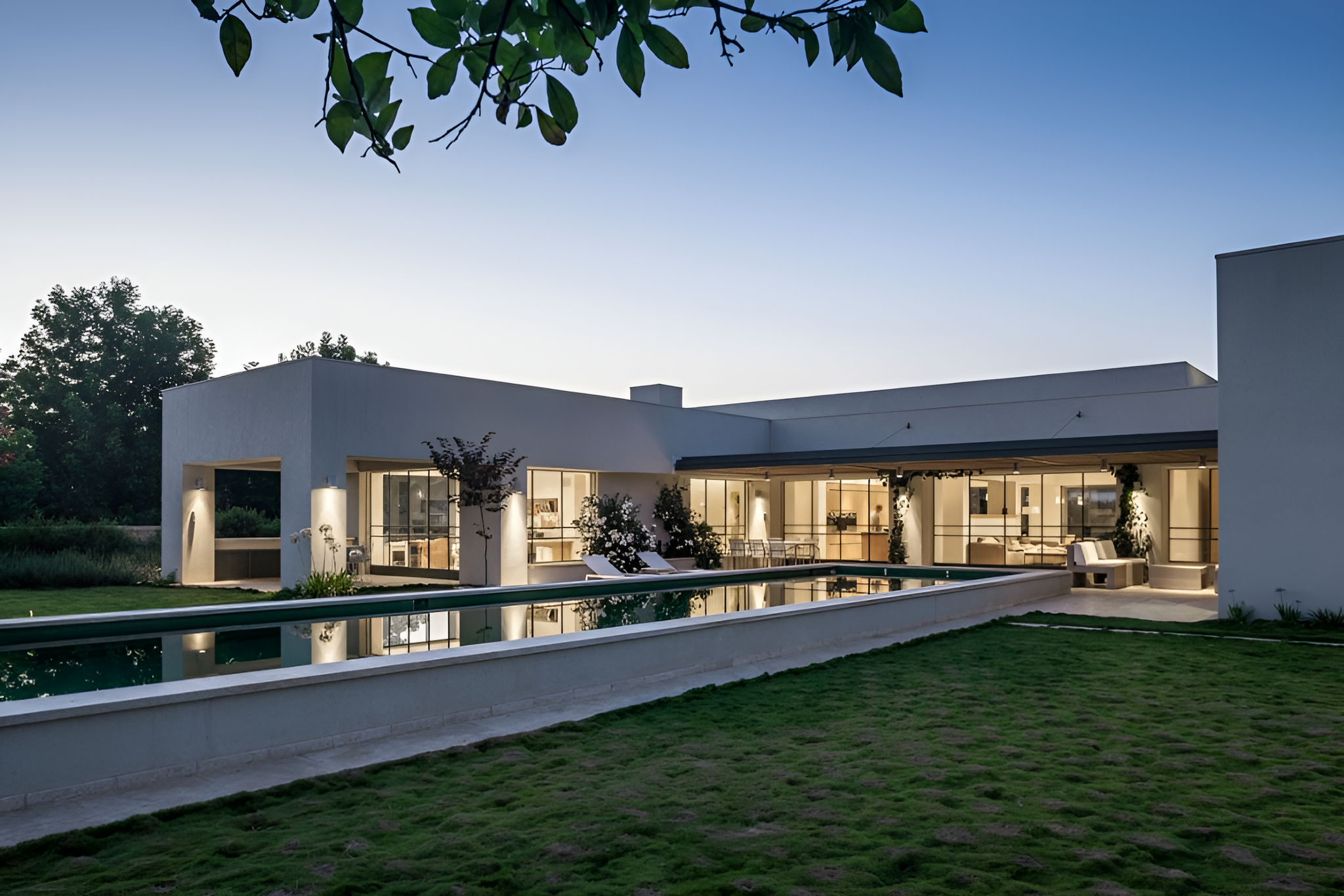
A site development consultant doesn’t design gardens – that’s a common misconception. A site development consultant is the professional responsible for positioning the structure relative to the topographic elevations of the plot, planning yard grades, pool placement, pathways, pergolas, retaining walls, and fire pits. Amit Marshansky, CEO of Marshanski Build with 25 years of experience building luxury properties in Israel, states that every plot of one dunam (quarter acre) or more requires a site development consultant – and for smaller plots, the decision depends on the budget and topographic complexity.
What Exactly Does a Site Development Consultant Do?
Many people confuse a site development consultant with a landscape architect or garden designer. In practice, this is an engineering role through and through. The site development consultant receives the topographic survey of the plot along with the architectural plans for the house, and develops a detailed plan that defines:
- Building placement on the plot – The precise elevation of the home’s entrance, floor levels relative to the street and property boundaries
- Yard elevations – Grade differences between various zones, drainage slopes, retaining wall placement
- Exterior element placement – Swimming pool, concrete access paths, parking areas, pergolas, and fire pits
- Drainage and stormwater management – Slope directions that prevent flooding and water infiltration into the building’s foundations
- Vehicle and transportation access – Ramps, entry slopes, curb heights
In essence, the site development consultant is the person who “seats” the house on the ground. Without them, the architect designs a house that floats in midair – disconnected from the physical reality of the plot.

Why Is Working With Elevations So Critical?
A private plot is almost never perfectly flat. A height difference of just one meter between one side of the plot and the other can dramatically affect how the house looks, construction costs, and quality of life for years to come. For example, incorrectly positioning the house on the plot can cause rainwater to flow toward the house instead of away from it – a drainage issue that can cost tens of thousands of shekels to fix.
An experienced site development consultant leverages elevation differences to benefit the project: creating a dramatic entrance to the home, terraces with views, sunken seating areas, and an infinity pool that appears to spill into the landscape. At Marshanski Build, we’ve seen projects where smart site development planning turned a “problematic” plot with a steep slope into a significant architectural advantage.
When Is Hiring a Site Development Consultant Mandatory and When Can You Skip It?
Amit Marshansky draws a clear line: Every plot of one dunam (1,000 sqm / ~10,700 sqft) or larger requires a site development consultant. The reason is simple – the larger the plot and the more topographic variation it has, the more options exist for element placement, and the greater the risk of costly mistakes without professional planning.
For plots smaller than one dunam, the decision depends on two key factors:
- Topographic complexity – A 500 sqm plot with a 3-meter elevation change requires a site development consultant regardless of its size
- Budget – The cost of a site development consultant ranges between 15,000–50,000 NIS (~$4,000–$14,000) depending on project size and complexity. For projects costing 25,000 NIS per sqm and above, this is a negligible amount relative to the savings it generates
Guideline Chart: When Do You Need a Site Development Consultant?
Here’s a simple guideline:
- Plot over one dunam – Mandatory, regardless of budget
- Plot under one dunam with significant slope (over 1.5m elevation change) – Highly recommended
- Small, flat plot (up to 500 sqm, minimal elevation change) – Not mandatory, but worth considering if the project includes a pool, retaining walls, or complex exterior elements

The Relationship Between the Site Development Consultant and Other Project Consultants
A site development consultant doesn’t work in a vacuum. They’re part of a team of consultants that must operate in complete sync. At Marshanski Build, which specializes in building luxury homes in Kfar Shmaryahu, Herzliya, Caesarea, and other high-demand areas, the management team coordinates between the site development consultant and:
- The architect – Who determines the house’s form and desired placement. Choosing an architect is the most significant decision in your building project, and the site development consultant translates the architectural vision into engineering reality
- The structural engineer – Who needs the precise elevations to design foundations
- The drainage consultant – Who ensures water flows in the right direction
- The landscape architect – Who enters the picture only after the site development consultant has established the elevations and placements. This is precisely the source of confusion: people think a site development consultant deals with vegetation, but they deal with engineering
When this coordination doesn’t happen, problems arise that cost far more than the consultant’s fee. We’ve seen cases where a swimming pool was built at the wrong elevation because there was no site development consultant, resulting in demolition and reconstruction – a cost that can reach hundreds of thousands of shekels in a luxury project.
Site Development Consulting in Luxury Construction: Why It’s Different
In luxury construction projects, the role of the site development consultant takes on heightened importance. On plots of 2–6 dunams – and in extreme cases like the largest house in Israel spanning 6,000 sqm, built by Amit Marshansky’s company – the site development consultant faces unique challenges:
- Complex systems – Outdoor underfloor heating, pathway lighting, irrigation systems, pool plumbing – all must be planned according to site development elevations
- Multiple elements – A luxury plot typically includes a pool, sports court, summer house, underground parking, ornamental garden, and multiple entertainment areas. Each element requires a precise grade level
- Long-term thinking – In luxury properties built with maintenance and preservation in mind over decades, site development planning must account for system maintenance accessibility, potential for future expansions, and durability of exterior materials

How Much Does a Site Development Consultant Cost and What’s the ROI?
The cost of a site development consultant for a private construction project ranges on average between 15,000–50,000 NIS (~$4,000–$14,000), with particularly large luxury projects reaching 80,000 NIS and above. This represents 0.3%–0.5% of the average luxury construction project cost.
The return on investment is significant: proper site development planning saves between 5% and 15% on earthwork and site development costs – which can total hundreds of thousands of shekels on a large project. Beyond direct savings, professional site development planning prevents drainage problems, water damage to foundations, and expensive post-occupancy repairs.
Frequently Asked Questions
What’s the difference between a site development consultant and a landscape architect?
A site development consultant deals with grading engineering, drainage, building placement, and element positioning on the plot. A landscape architect focuses on vegetation design, decorative material selection, and the aesthetics of the outdoor space. The site development consultant works first, and the landscape architect builds upon their plan.
Is a site development consultant required for a building permit?
Yes. In most local authorities in Israel, a site development plan signed by a certified professional is part of the requirements for obtaining a building permit. Even if it weren’t legally required, from a professional standpoint it’s a basic requirement for any construction project.
At what stage of the construction process should the site development consultant be involved?
The site development consultant should join the project during the initial planning stages, working in parallel with the architect. The later they come in, the greater the likelihood of costly plan changes.
Is a site development consultant relevant for renovations, not just new construction?
Absolutely. In significant renovation projects, especially when adding a swimming pool, redesigning the yard, or building an addition – a site development consultant ensures the changes integrate with existing elevations and don’t compromise drainage.
How long does it take to prepare a site development plan?
Site development planning for a standard private plot takes 2–4 weeks. For large and complex plots (over 2 dunams with significant elevation changes), the process can take 6–8 weeks including coordination with other consultants.
Conclusion: A Site Development Consultant Isn’t a Luxury – It’s a Necessity
A site development consultant is one of the least recognized professionals in a construction project, yet their impact on the final outcome is enormous. They don’t deal with flowers and lawns – they deal with the engineering that connects the house to the ground. Amit Marshansky’s company, which has built the most prestigious properties in Israel over 25 years, considers the site development consultant an integral part of every project over one dunam.
Planning to build a private home and want to understand which consultants you need? Contact the Marshanski Build team for professional guidance and to understand your project’s structure – marshanski.com.