

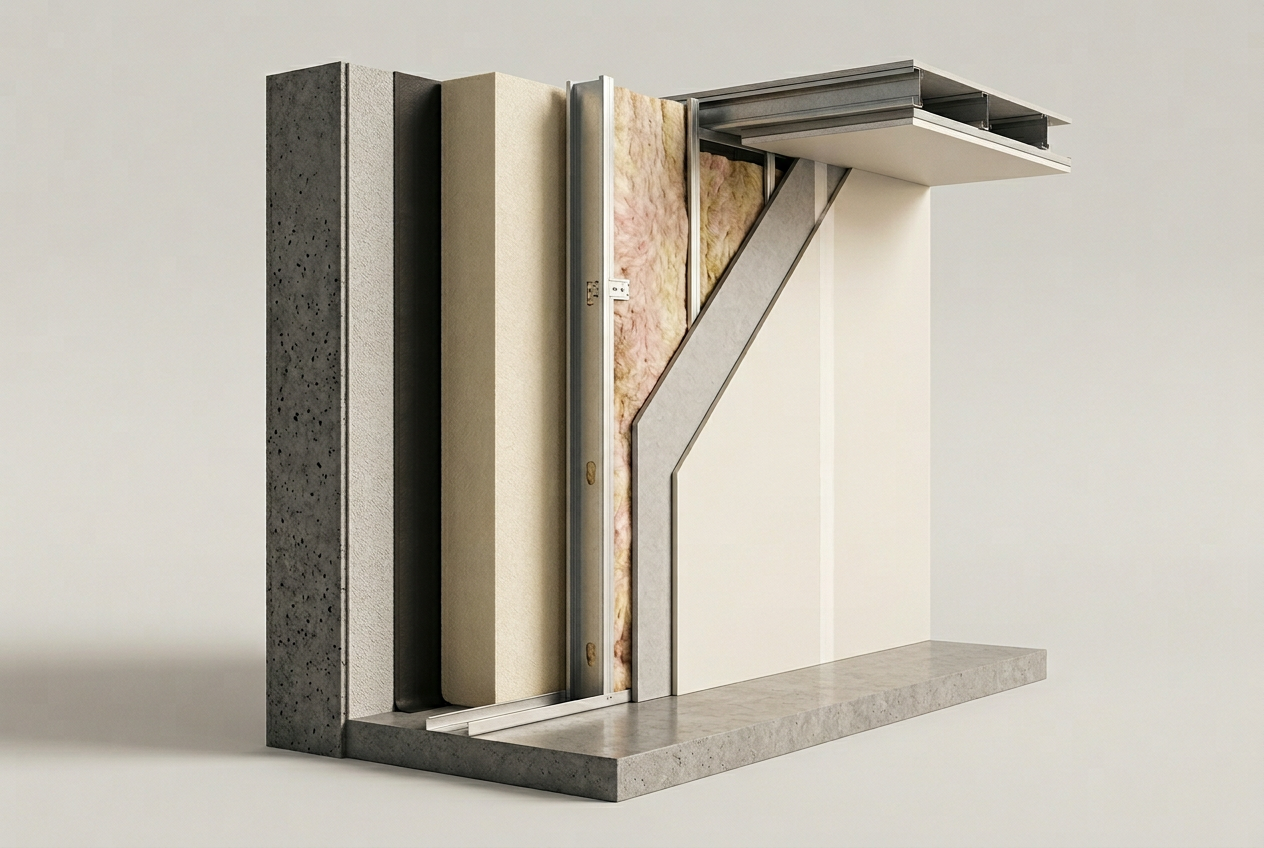
The ideal exterior wall cross-section in a luxury home consists of three layers: an outer finish (plaster, Dekton, or tile cladding), a solid 20–30 cm reinforced concrete structural wall, and an interior lining of double-layer chromatic gypsum board. This all-concrete approach eliminates thermal bridges, removes cold joints between materials, and creates a monolithic structure that outperforms traditional block-and-column construction in every measurable way. Amit Marshanski, who has built Israel’s most expensive private residences over 25 years — including a 6,000 sqm Hermitage-style mansion — considers full concrete construction non-negotiable for any home built at ₪25,000+ per square meter.
The Question Every Luxury Client Asks: Blocks or Concrete?
It comes up in nearly every initial consultation. A client planning a high-end private home asks: “Can we use concrete block masonry for the exterior walls?” The question is understandable — for decades, Israeli construction followed a standard formula: concrete columns and floor slabs for the skeleton, with hollow block infill for exterior and partition walls. It was cheaper. It was familiar. And for standard residential construction, it was adequate.
But adequate is the enemy of exceptional. When you’re investing ₪25,000 to ₪50,000 per square meter on a luxury residence, the wall assembly isn’t just a separator between inside and outside — it’s the primary envelope protecting tens of millions of shekels in finishes, systems, and comfort. The wrong wall section creates problems that no amount of expensive marble or smart-home technology can fix.

Why Full Concrete Construction Is the Only Right Choice
Marshanski Build’s recommendation is unequivocal: build the entire structure — columns, slabs, and all exterior walls — from reinforced concrete. Yes, it costs more. Concrete walls run approximately 15–25% higher than block infill walls when you factor in formwork, reinforcement, and pouring labor. But the benefits are transformational.
A Monolithic, Unified Structure
When exterior walls are poured as part of the concrete skeleton, the entire building becomes one continuous structural unit. There are no joints between columns and block infill — joints that are notorious for cracking, moisture penetration, and structural movement over time. A monolithic concrete structure distributes loads evenly, resists seismic forces better, and maintains its integrity for generations.
Elimination of Thermal Bridges
Thermal bridges — points where heat or cold transfers through the building envelope — are the silent killers of building performance. In traditional block construction, every junction between a concrete column and the adjacent blockwork creates a thermal bridge. These bridges cause condensation, mold growth, energy waste, and uncomfortable cold spots on interior wall surfaces during winter. A continuous concrete wall, properly insulated from the inside, eliminates these weak points entirely.
No “Tziporim” (Cold Joints)
In Hebrew construction terminology, “tziporim” refers to the gaps and imperfect bonds that form between dissimilar materials — typically where block masonry meets structural concrete. These joints are inherently weaker than either material alone. Over 10–20 years, they become pathways for water infiltration, air leakage, and cracking. In luxury construction, where facade finishes alone can cost ₪2,000–5,000 per sqm, a crack propagating from a cold joint is an expensive disaster.

The Recommended Wall Cross-Section: Layer by Layer
Based on 25 years of building Israel’s most demanding residential projects, here is the exterior wall assembly Marshanski Build specifies for luxury homes:
- Exterior Finish (outermost layer): This is the visible face of the building. Options include high-quality plaster systems, Dekton sintered stone panels, porcelain tile cladding, natural stone, or exposed architectural concrete. The choice depends on the architectural design, but the substrate remains the same regardless.
- Structural Concrete Wall (core): A 20–30 cm reinforced concrete wall, with thickness determined by the structural engineer based on loads, spans, and building height. This is the backbone of the wall — providing structure, mass, and acoustic separation simultaneously.
- Interior Gypsum Lining (innermost layer): Double-layer, double-chromatic gypsum board mounted on a metal stud framework with insulation in the cavity. This layer provides thermal insulation, conceals electrical and communication conduits, creates a perfectly flat surface for interior finishes, and adds an additional moisture barrier.
This three-layer system delivers thermal performance (U-values well below Israeli code requirements), acoustic isolation exceeding 55 dB STC, and a service life measured in many decades rather than years.
The Interior Gypsum Layer: More Than Just a Finish
Many clients question the gypsum board lining — why not simply plaster the interior face of the concrete wall? The answer involves both performance and practicality.
The double-layer gypsum system creates a cavity — typically 5–10 cm deep — that serves multiple critical functions. First, it houses the dozens of building systems that run through walls in a modern luxury home: electrical wiring, low-voltage communication cables, smart-home bus wiring, central vacuum piping, and sometimes even hydronic heating lines. Running these through a gypsum cavity is cleaner and more maintainable than chasing channels into concrete.
Second, the insulation within the cavity (typically mineral wool or XPS board) provides the primary thermal break. Concrete is an excellent structural material but a mediocre insulator. The insulated gypsum layer transforms the wall from a thermal liability into a high-performance envelope.
Third, double-layer gypsum is more dimensionally stable and impact-resistant than single-layer. In a home where interior wall finishes might include Venetian plaster at ₪400–800 per sqm or imported wallcoverings, the substrate needs to be perfectly stable.
What About Exposed Concrete Interiors?
Modern architectural design frequently calls for exposed concrete walls inside the home — the raw, honest aesthetic of board-formed or polished concrete. In these cases, the question becomes simpler: if the concrete itself is the finish, there’s no debate about whether to use blocks. You need poured concrete by definition.
But even in homes with predominantly exposed concrete interiors, not every wall should be left bare. Perimeter walls facing exterior conditions still benefit from the insulated gypsum system on certain elevations, particularly north-facing walls that receive no solar gain. The architect and builder must collaborate to determine which walls are expressed as concrete and which receive the full insulated assembly — it’s a design and engineering decision that requires careful coordination between architect and contractor.
Long-Term Thinking: Why This Matters for Maintenance
One of Marshanski Build’s core principles — and a key differentiator from competitors — is designing and building with long-term maintenance in mind. A concrete wall assembly pays dividends over the life of the building in ways that block construction simply cannot match.
Consider waterproofing: a monolithic concrete wall has no mortar joints between blocks that can deteriorate. It has no micro-cracks at dissimilar material junctions. When properly waterproofed externally (with membrane systems or cementitious coatings), a concrete wall can remain water-tight for 50+ years with minimal maintenance. Block walls, by contrast, rely on continuous mortar joints and plaster coats that inevitably develop hairline cracks — particularly in Israel’s climate, where daily temperature swings of 15–20°C create constant thermal expansion and contraction.
This long-term perspective extends to every detail. At Marshanski Build, the waterproofing and finishing details applied to luxury projects are among the best available globally, selected through decades of experience building Israel’s most demanding residences.
Cost Perspective: The Investment vs. the Return
The additional cost of full concrete exterior walls over block infill typically adds ₪800–1,500 per linear meter of wall, depending on wall height and thickness. For a 400 sqm luxury home with approximately 120 linear meters of exterior wall perimeter, that translates to roughly ₪100,000–180,000 in additional structural cost.
In a project with a total construction budget of ₪10–20 million (at ₪25,000–50,000/sqm), this premium represents less than 1–2% of total project cost. It’s a fraction of what clients spend on kitchen cabinetry alone. Yet it affects every square centimeter of the building’s performance envelope for the entire life of the structure.
Frequently Asked Questions
Can you build a luxury home with concrete blocks instead of poured concrete walls?
Technically yes, but it’s not recommended. Block infill walls create thermal bridges, cold joints (“tziporim”), and material discontinuities that compromise insulation, waterproofing, and long-term durability. For homes built at ₪25,000+ per sqm, the additional cost of full concrete construction is marginal — typically under 2% of total project cost.
How thick should exterior concrete walls be in a luxury home?
Exterior concrete walls are typically 20–30 cm thick, as determined by the structural engineer. The exact dimension depends on building height, span distances, seismic requirements, and load calculations. Most single-story luxury homes use 20 cm walls, while multi-story structures may require 25–30 cm.
Why use double-layer gypsum board instead of plastering directly on concrete?
Double-layer gypsum board creates a service cavity for electrical, data, and smart-home wiring; houses thermal insulation that dramatically improves energy performance; and provides a perfectly flat, stable substrate for high-end interior finishes. Direct plaster on concrete offers none of these benefits.
What exterior cladding options work best over concrete walls?
The most common options for luxury homes in Israel include: quality plaster systems (acrylic or silicone-based), Dekton sintered stone panels, large-format porcelain tiles, natural stone (limestone, granite, or marble), and exposed architectural concrete. The concrete substrate accommodates all of these equally well.
Does full concrete construction improve the home’s resale value?
Yes. Concrete construction is recognized by property assessors and high-end buyers as a superior building method. It offers better structural integrity, lower maintenance costs, superior acoustic and thermal performance, and a significantly longer service life — all factors that support premium valuations.
The Bottom Line
Building luxury means making decisions that prioritize performance, longevity, and quality over short-term savings. The exterior wall cross-section is one of the most consequential decisions in any residential project — it determines how the building performs thermally, acoustically, and structurally for decades to come. Full concrete construction with proper insulated gypsum lining isn’t just better; for luxury homes, it’s the only approach that makes sense.
Planning a luxury home in Israel? Contact Marshanski Build to discuss your project’s structural approach, wall assemblies, and the construction details that separate truly exceptional homes from ordinary ones. With 25 years of experience building Israel’s finest residences, Amit Marshanski and his team bring unmatched expertise to every detail — from foundation to finish.